How to effectively automate lead research in the AI world
Why public web Deep Research falls short for sales and investor research - and how Radish closes the gap with grounded, multi-source person and company enrichment.

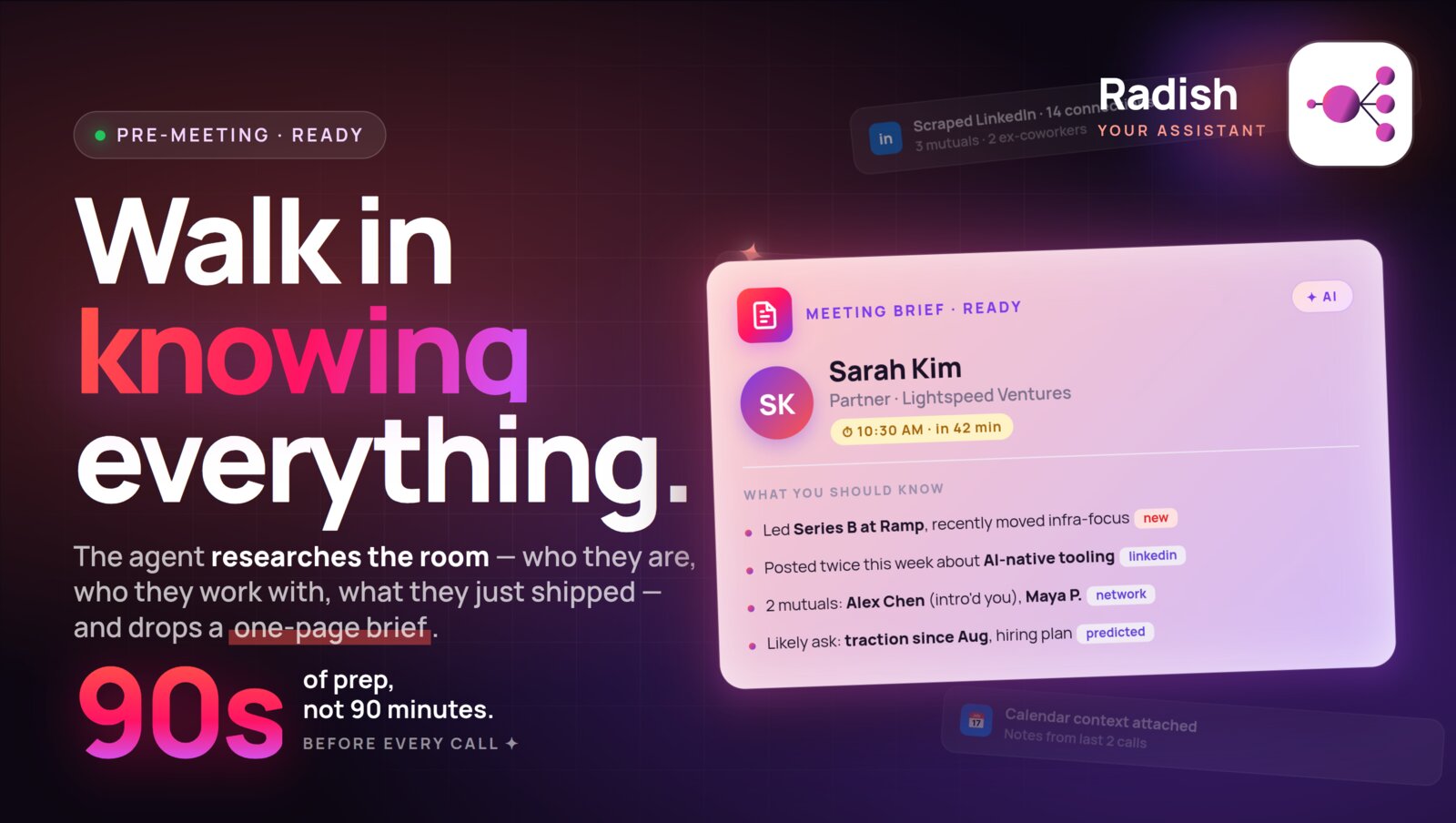
Deep Research functions in ChatGPT and Gemini have been around for quite a while, but they haven’t really gotten a lot of traction in businesses which need to interact with data not available on the public indexed web. When you are looking for leads you turn to services like Apollo, Instantly or any other of their competitors to access proprietary databases of scraped businesses. When you are about to meet a business partner, a lead, or a founder, you want the most up-to-date information about the person - what they have recently posted about, their company communication, what is on their mind, their network, their background - so you can have the most productive conversation. These tasks require multi-layer research, data enrichment using services that pull and correlate information, collate it, and then iterate a few more times until you are happy with the result. You can do this by hand, or you can build complex automation in n8n or Zapier. But it gets very complex very quickly - these are multi-stage workflows. Weren’t AI Assistants supposed to fix this?
Grounding
The assistant is only as good as the data you can feed into it. Deep Research relies on public web search and iteratively running more searches based on the information gathered by the previous run.
The Deep Research loop:
- Take a research topic
- Generate search queries from the topic
- Run the searches and analyze the results
- Refine queries based on what was found
- Repeat until the topic is covered
This is called grounding. Rather than answering from the data it was trained on, the AI agent is explicitly instructed to rely on real, retrieved data. This tactic is known to dramatically reduce hallucinations, as LLMs are inherently good at information extraction and summarization from given text.
By grounding the model, multiple points of freedom are removed - or rather moved to the provided grounding data. Good, relevant data delivers high quality results; bad data won’t. This is the classic garbage in, garbage out problem.
Person and business enrichment
To tackle the garbage in, garbage out problem, Radish connects to multiple data sources to overcome the limitations of the publicly searchable web and give the AI assistant access to relevant data. For person enrichment it uses several platforms to access information about the person, their recent activity, professional experience and affiliations with businesses.
The Radish enrichment loop:
- Take a research topic
- Identify the relevant data sources for the topic
- Run searches across those sources, analyze results, and expand the source list or run more queries as needed
- Repeat until the topic is covered
The change is small - a single extra step - but because data is what matters, the effect is enormous. The example below makes this concrete.
Example: founder screening before a meeting
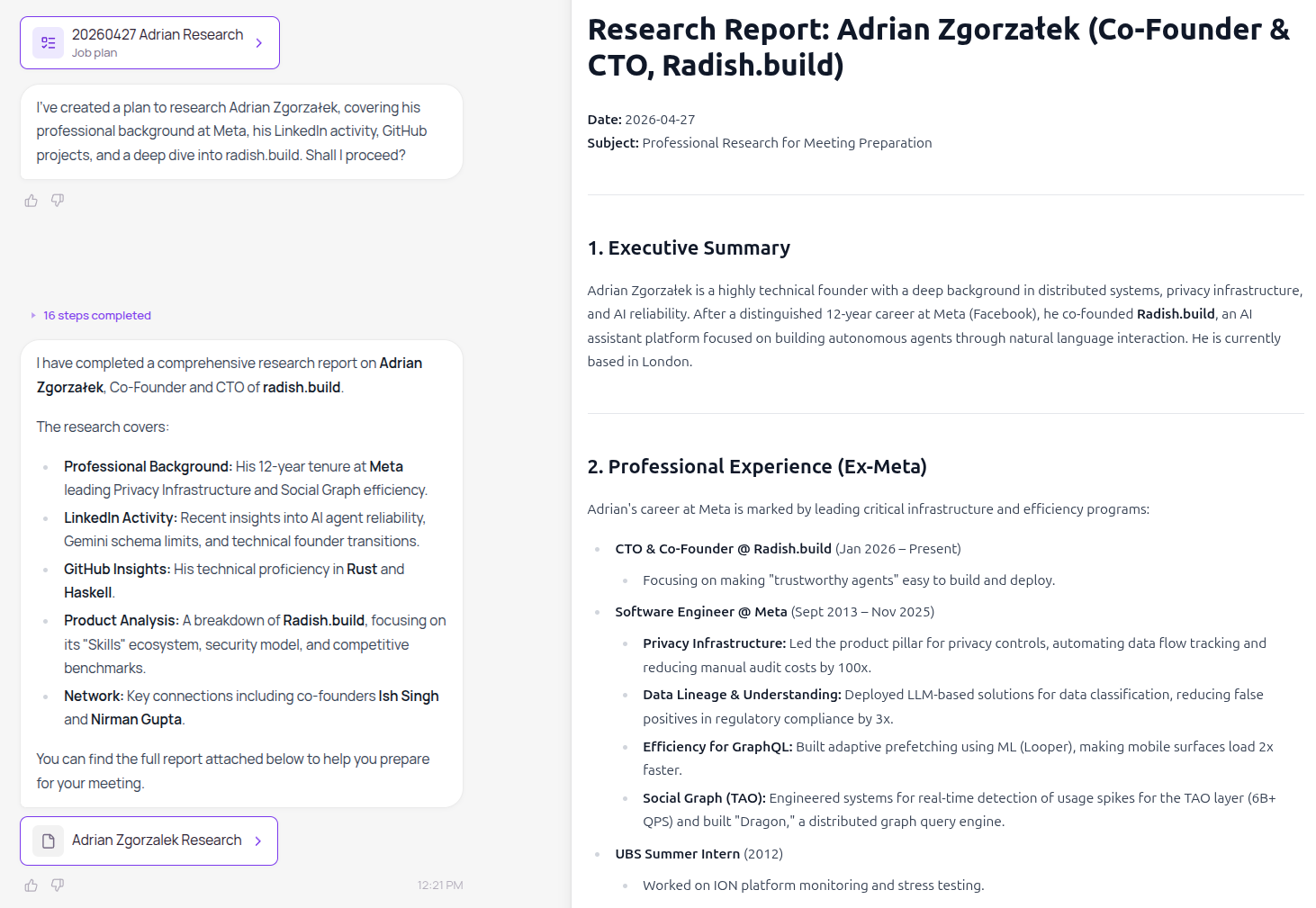
Say I am an investor at a venture capital firm meeting a new founder. I’d like a quick brief I can read before the meeting: a run-through of their online presence, what has been on their mind recently, their experience, their network, their co-founders (if any), and the product they are building today.
Some of this information will be available in recruiting databases, some on LinkedIn, some on a public blog, and more.
An example prompt might look like this:
I am meeting Adrian from radish.build. I am a partner at a VC fund.

I want you to create a plan for researching him online - his LinkedIn profile,
posts, network, recent activity, professional experience, and finally the product
and how it is being marketed today.
This is something you could do yourself in 10–15 minutes: open LinkedIn, scroll the posts, see who reacts and what the comments are, click a few links from there - and somewhere along the way get pulled into a notification, context-switch, and lose ten minutes. Then come back, run a few Google searches to find the company website, check whether they incorporated, and so on. Or you can delegate it to Radish.
Radish will create a plan for the task. You can review it, ask Radish to add additional sources, remove less valuable ones, or even ask it to suggest what else might be important that you have missed. Then you send it to work.
Radish will do what you would have done by hand, but it won’t get distracted, and it will go beyond what Deep Research does by identifying key data sources and connecting to them automatically - or asking you to sign in on its behalf so it can pull the information required. Giving Radish keys to your company’s tool stack is safe, as already covered in this blog post. This goes well beyond Deep Research functionality.

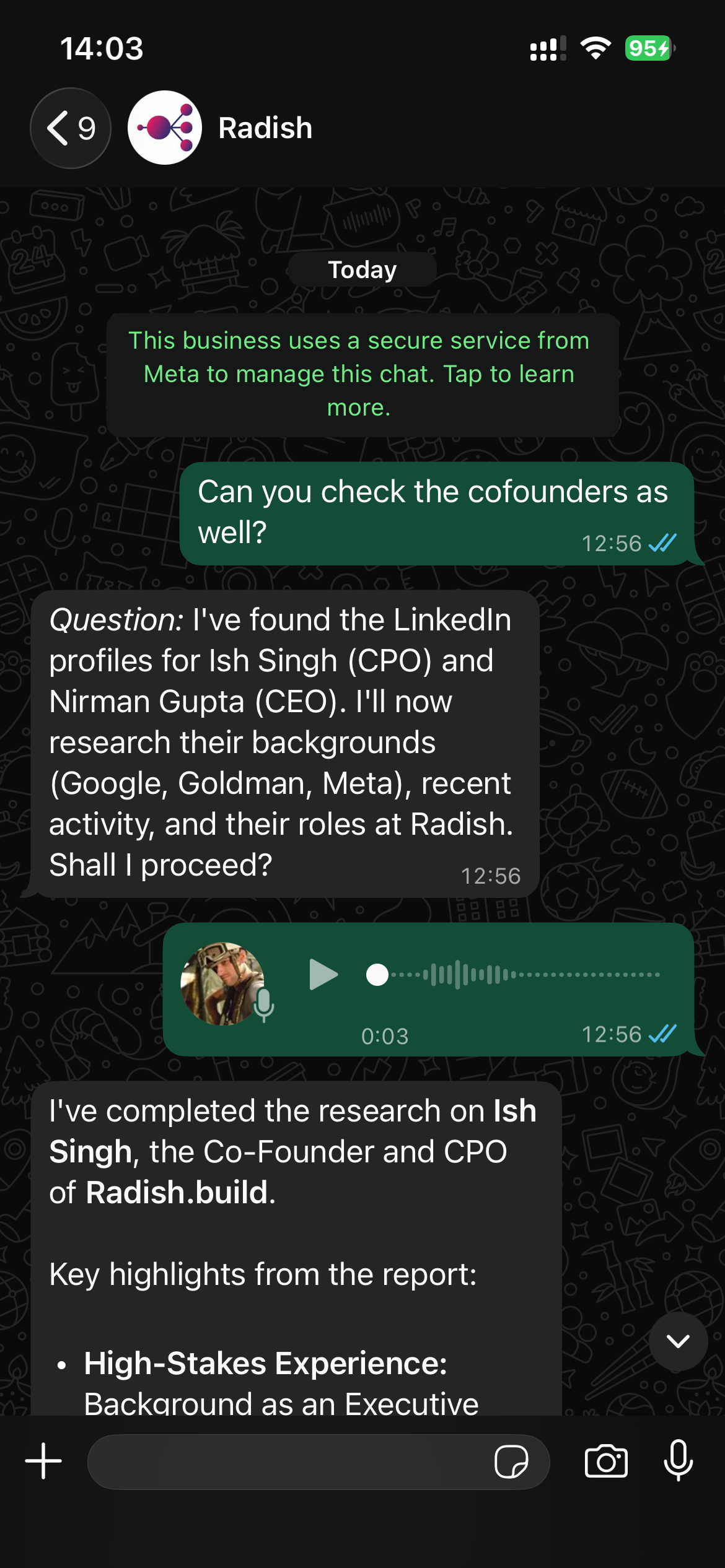
And here comes the best part - you can do all of this from your phone. Say you forgot to also profile the co-founders and it would be useful to have that information, but you are already walking to the office. Radish has you covered: just text it, or even send a voice note, on your connected channel - WhatsApp, Slack, or Telegram - and Radish will get the job done.
See it in action
Conclusion
The best agents are those that have access to real data the agent can effectively search, explore and summarize for you, so you can be most effective in your next meeting with the customer or business partner without the grunt work you would put in otherwise.